
A buyer is looking for a supplier and asks ChatGPT. He gets three names, a paragraph of reasoning and a handful of sources. He clicks on none of them — after all, he has an answer. Whether your company appears at that moment is decided long before, and in a place most marketing departments do not have on their radar: in Bing’s index.
Because AI systems do not invent their evidence. They draw on what search engines have indexed — and, depending on the system, on a different index.
Fig. 1 · Key figure
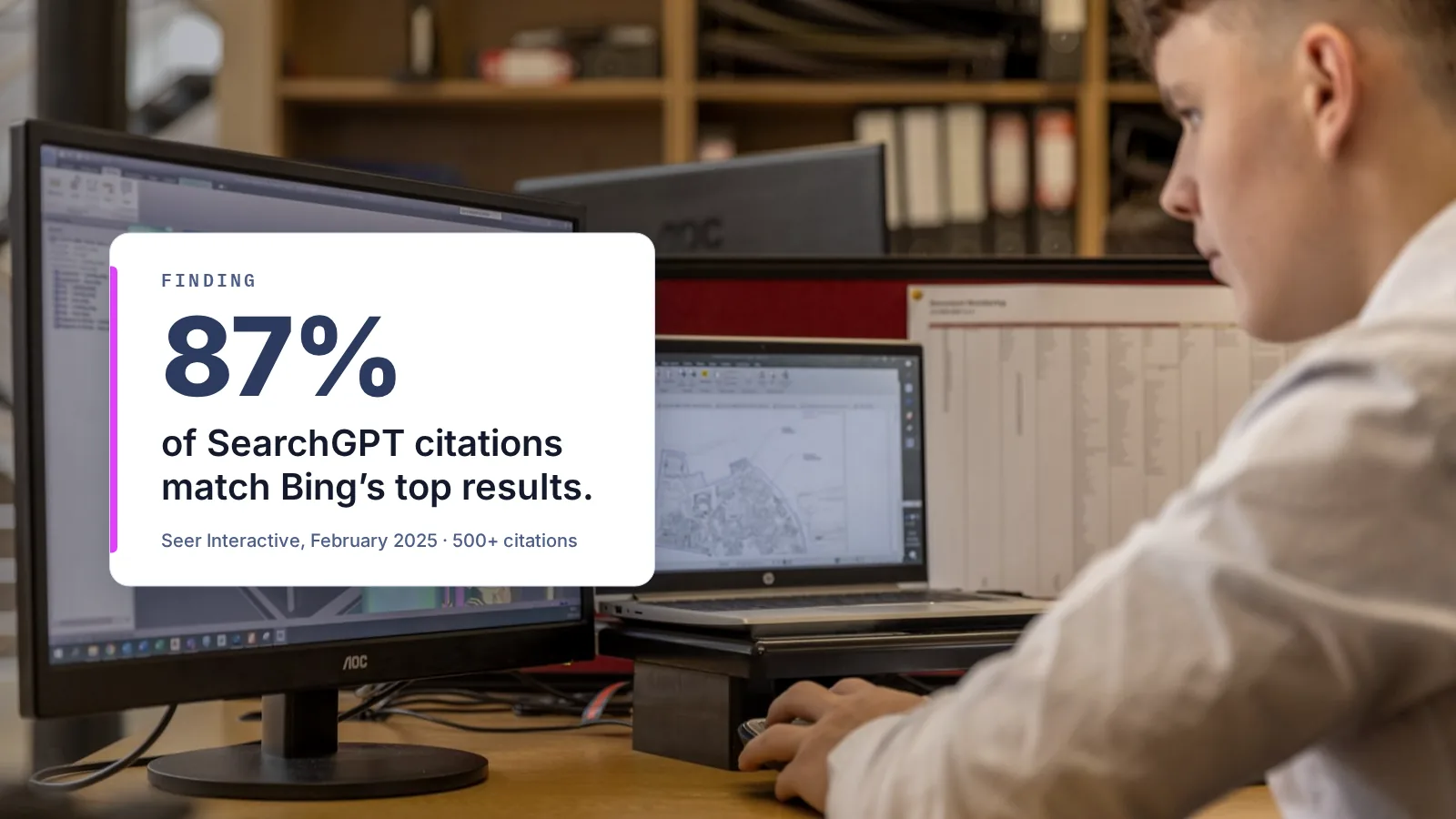
ChatGPT cites what ranks at the top of Bing
Why Bing has a say in your visibility in ChatGPT
The selection of sources is not a mystery, it is a search query. Before an AI system answers, it searches — and what it finds depends on which index it asks.
Seer Interactive has measured this. For the study “87% of SearchGPT Citations Match Bing’s Top Results”, more than 500 citations from 100 questions were compared with the organic results of both providers. The result: 87% of the cited pages were found in Bing’s top results, but only 56% in Google’s — and there with a median rank of 17, well beyond the first page.
Two caveats belong with this, so that the figure holds up: the study dates from February 2025 and covers the English-language US market. And it measures a match, not a cause — Seer checks whether the same pages appear, not why.
For practical purposes the finding is uncomfortable all the same. Many German B2B companies do SEO with Google exclusively in mind. Bing is regarded as marginal because its market share among human users is small. For the question of what ChatGPT finds as evidence, however, that market share is irrelevant.
What follows from this is unspectacular and still rarely done: set up Bing Webmaster Tools, submit your sitemap there, read the index coverage report. Bing indexes independently and more slowly than Google; pages that have long been listed on Google are sometimes missing there entirely. That is not optimisation, it is a stocktake — and it takes an afternoon.
Fig. 2 · Process
Why the Bing index has a say in visibility in ChatGPT
- 1Buyer questionChatGPT is not sure of the answer
- 2Web searchThe question is translated into search queries
- 3Search indexMainly Bing supplies the candidates Pages Bing does not know drop out here
- 4Reading pagesPassages from the top results are evaluated
- 5Answer with citationsThe pages used appear as sources
The number of slots is not the problem
There is a widespread notion that an AI answer relies on two to five sources, so it is all about a few hard-fought slots. That figure does not stand up to measurement.
SISTRIX analysed many millions of answers for the German Google AI Mode: an answer contains around 15 source links on average. Space as such is not scarce.
What is scarce is something else. According to SISTRIX measurements, only 42.2% of all AI Mode answers contain any brand reference at all. In the majority of answers not a single company name comes up — things are explained, not recommended. The real question is therefore not “How do I get into the top five sources?”, but: is my category one of those in which AI systems name names at all? And if so — whose?
That is also why measurement comes at the start and not at the end. Whether names come up in your buyer questions can be found out in an hour. Without that answer, you are optimising in the dark.
What sets the systems apart
“AI search” is not a single thing. The systems draw on different indexes and cite differently.
| System | Where the evidence comes from | What follows from it |
|---|---|---|
| ChatGPT | Web search via Bing | Check the Bing index, not just Google |
| Google AI Overviews / AI Mode | Google’s own index | Classic Google SEO remains the foundation |
| Perplexity | Its own crawler plus search indexes | Technical accessibility is particularly important |
This separation has a practical consequence that runs counter to intuition: there is no “AI optimisation” that works the same everywhere. Ahrefs compared 76.7 million AI Overviews with almost a million ChatGPT and Perplexity answers — of the 50 most-mentioned websites in each, only seven appear in all three systems. If you want broad visibility, you work on several fronts; if you know where your buyers search, you can skip two of them.
Why freshness counts for more than publishing frequency
A finding from the same research series clears up a widespread misconception. For the study “Content Recency’s Impact on AI Visibility in 2026”, Seer Interactive analysed 7,683 pages with 47,097 citations from ChatGPT, Gemini and Perplexity.
75% of the cited pages had been updated in the past year — but only 42% had been published in the past year. The freshness AI systems prefer therefore comes mainly from revision, not from new production.
The second finding is even clearer: pages cited every month are, on average, less often freshly revised than those that turn up only once (68 versus 86% updated in the past year). Lasting visibility is therefore not a question of publishing pace.
For a marketing team with limited time, that is good news. Revising the ten pages that answer your most important questions on a fixed cycle is more effective — and cheaper — than producing a new text every month that is then left to gather dust.
What is shifting right now: ranking alone is less and less enough
A finding from spring 2026 changes the calculation. Ahrefs matched 863,000 keyword SERPs against four million cited AI Overview URLs: in July 2025, 76% of citations still came from the Google top 10 — in February 2026 it was 38%.
Half of the evidence now comes from pages that are not on page 1 for the same question. A good ranking remains the ticket of entry, but it is less and less often the sole deciding factor.
That matches an observation many marketing managers know from their own experience: companies with more than a hundred top-10 rankings still do not appear in AI answers. Classic search engines evaluate pages. AI systems evaluate evidence — and evidence is stronger when it does not come from the party in question.
In practice this means two things. First, looking at the ranking list underestimates the problem, because it does not even ask the question that counts. Second, the work does not stop at your own domain boundary. If you want to appear in the answers, you also have to appear where others write about your category — on trade portals, in comparison lists, on review platforms.
That is not an argument against SEO. It is an argument for not confusing SEO with AI visibility.
What you can do on your own pages
Four things can be influenced. None of them is a trick; all four are a matter of craft.
1. The answer comes first
AI systems extract statements, not narrative arcs. A section that starts with the answer and then gives the reasons can be lifted out as evidence. One that builds up to it over three paragraphs cannot.
In practice this means: every subheading asks a question someone actually asks, and the first sentence beneath it answers it. What follows is the reasoning.
2. Every statement carries its evidence
A statement with a named source can be verified; one without cannot. That applies to figures, standards and dates. Writing “studies show” delivers nothing citable — writing who measured what, when and with which sample does.
It is also the best self-test for a text: if a claim cannot be written down together with its origin, it usually does not belong in it.
3. The page must be machine-readable
What a crawler cannot load, no system can cite. This concerns accessibility for AI crawlers and whether content sits in the delivered HTML or only appears later via JavaScript. We have written this up in a separate article on technical AI accessibility.
4. Existing pages come before new pages
See above: the update cycle beats publishing frequency. A realistic rhythm is to go through your most important pages twice a year — check the figures, update the sources, add sections that are now missing.
What you cannot influence
The honest part. There is no bookable placement in an AI system. No provider sells mentions, and the same question may be answered differently tomorrow. Anyone guaranteeing a placement is promising something that does not exist technically.
The impact is also more limited than the excitement suggests. The loss of clicks caused by AI Overviews is real, but unevenly distributed: SISTRIX puts it at an average of 6.6% of all organic clicks, ranging from 1% for recipes to 24% for parenting portals. And AI Overviews currently appear in Germany for around 17% of search queries — with a stagnating, not a rising, trend.
The honest argument is therefore not visitor volume. It is the preliminary decision: if you do not appear in the answer, you are not on any list that gets checked afterwards. That affects few searches — but it affects them at the point where the selection is made.
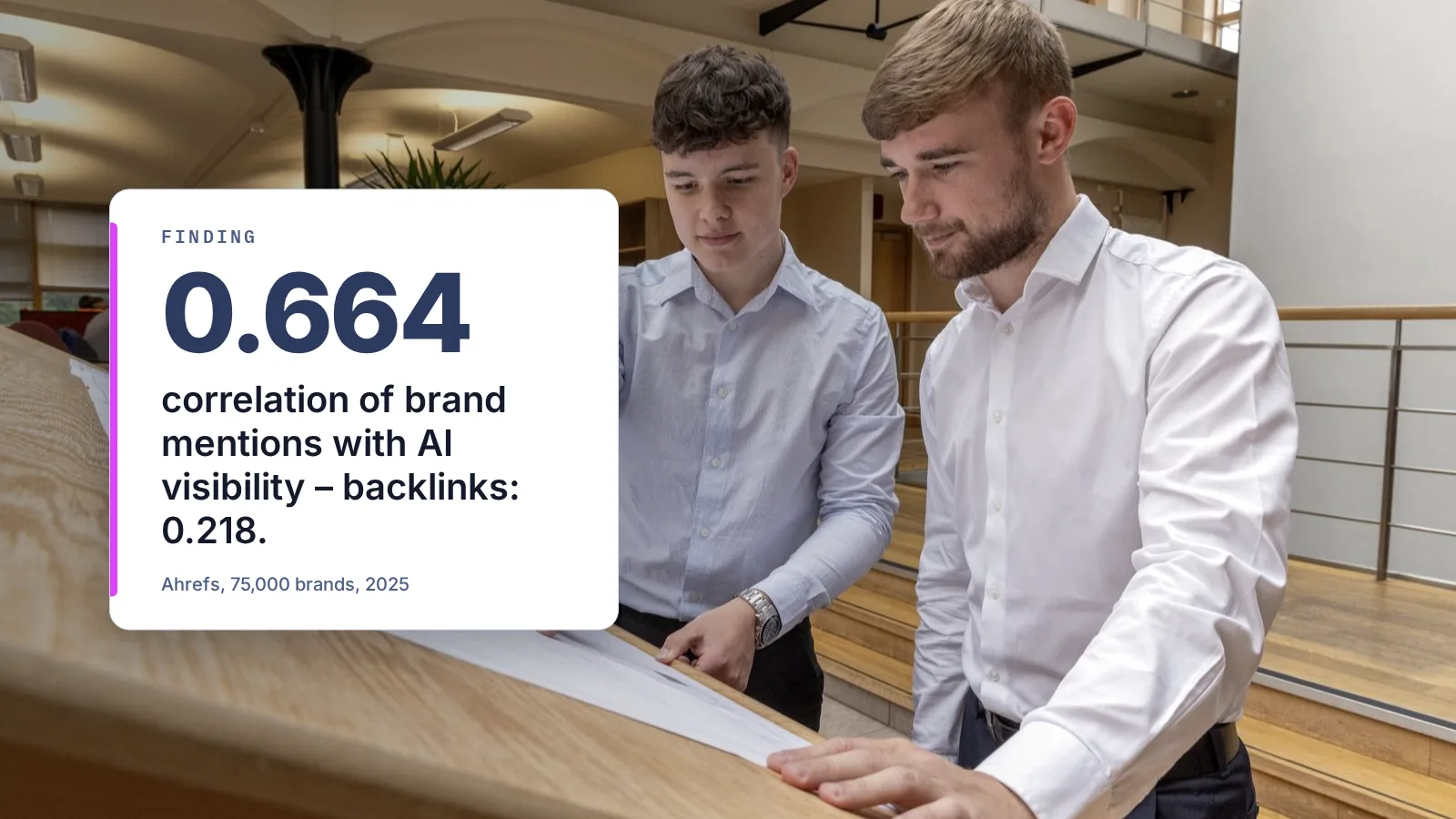
And one finding marks the limit of your own website: according to the Seer analysis, only around 2% of the pages cited in connection with a brand belong to that brand itself. The remaining 98% are third-party pages. Optimising your own pages is therefore necessary, but not sufficient on its own — if you want to be named, you also need mentions where others write about you.
How this can be measured
Without measurement, any statement about impact is an assertion. Three things can be established without additional tools:
- The same questions, the same wording, every month. Take eight questions your sales team actually hears and put them to ChatGPT and to Google search with AI Overviews. Note which providers are named and which sources the systems cite. Different wording produces different answers and makes the comparison worthless.
- Check the Bing index. In Bing Webmaster Tools you can see which of your pages are known there at all. That is the precondition for everything else in ChatGPT. What comes next, so that ChatGPT does not just find you but names you as a supplier, is set out in the article Getting recommended by ChatGPT as a supplier.
- Read Search Console. Since June 2026, Google has shown a filter for AI Overview and AI Mode under Performance → Search results. It shows impressions only — no clicks, no search queries, no click-through rate. That is not much, but it is the only official figure there is.
An important point of context: AI answers are not deterministic. The same question may be answered differently today than tomorrow. What is defensible is therefore a statement about the trend, not about a single day — even when the line stays flat.
Where this fits in the bigger picture
Google and Bing optimisation is a building block in its own right for us and belongs to the first visibility tier, “Found” — the tier that answers the question: can AI read and cite my company at all? It sits there not out of tradition, but because it is the precondition. What is in no index cannot turn up in any answer.
The second tier takes care of what this work cannot achieve on its own: the mentions outside your website that make up the 98%.
Would you like to see what AI systems currently say about your company? We put eight real buyer questions from your sector to ChatGPT and Google AI Overviews and show you which of them leave your name out — and which competitor is recommended instead. Request your free audit.
The terms behind this are in the GEO glossary: web search, initial retrieval, freshness, index management. Which pages ChatGPT cites most often is covered in what ChatGPT cites; how to measure your own mentions in the analysis of 7,184 AI answers.