of buyer questions produce no mention
In more than half of the questions, the company under review appears in no AI answer at all — and nobody notices, because a non-mention shows up in no statistic.
Data analysis · AI Blind Test 2026
We put the questions of real buyers to AI assistants — about 449 mid-sized companies in Germany. The result is, to our knowledge, the most comprehensive analysis of AI visibility among mid-sized companies in the German-speaking market to date. It is not a reassuring one.
Key findings
In more than half of the questions, the company under review appears in no AI answer at all — and nobody notices, because a non-mention shows up in no statistic.
For almost every second company the AI recommends the competition by name, while the company itself is missing from the majority of its core questions on its own products and services.
More than a third of the companies with over 100 top-10 rankings are completely invisible in ChatGPT. Classic SEO strength is no protection.
Abstract
B2B buying decisions increasingly start inside AI answers — long before any supplier is contacted. This analysis measures whether mid-sized companies appear there. For each company, eight realistic buyer questions were put to ChatGPT and Google AI Overviews, and the answers were evaluated systematically: is the company mentioned? In which position? Who is recommended instead? Is the company's own website cited as a source?
The result: in 54.7 % of all questions the company in question is not mentioned. For 46.8 % of the companies, the AI systems recommend competitors by name while the company itself is missing from the majority of its core questions. And even strong Google rankings are no protection: 34.9 % of the organically well-visible companies are completely invisible in ChatGPT.
Results
In 1,965 of 3,592 questions, the company in question appears in neither of the two AI answers. The majority of buying journeys therefore happen without the company — and nobody notices, because a non-mention shows up in no statistic.
For 210 of 449 companies, the AI systems recommend competitors by name while the company itself is missing from the majority of its questions. 12.9 % are replaced entirely: zero mentions across eight questions — the competition stands in every answer.
361 of the companies analysed have more than 100 top-10 rankings on Google. One in three of them (34.9 %) is still completely invisible in ChatGPT. Classic SEO strength and AI visibility are two different disciplines.
Every fourth company is not mentioned even in the market-overview question about its own category ("Which providers of … are considered leading?"). Whoever is missing here does not exist for the discovery phase of their industry.
Additional metrics: where companies are mentioned, they stand at position 1.8 on average; in 23.8 % of all questions the company reaches first place. For 39 % of the companies, their own website is cited as a source in no answer at all — the AI describes these firms exclusively on the basis of third parties. A conservative model calculation puts the median opportunity at around €47,000 per company per year (context).
Platform comparison
The same questions, two systems, two realities: ChatGPT answers mostly from training data — whoever is missing there is missing structurally and can hardly correct that in the short term. Google AI Overviews draws more heavily on the live index.
39.6 % of the companies are never mentioned by ChatGPT.
15.1 % of the companies appear in no answer here either.
From the dataset
Original questions from the survey, translated from German. Company and competitor names are anonymised out of fairness — in the individual audits they appear in plain text.
Manufacturer of emergency and safety lighting
approx. 880 top-10 rankings on Google — organically well visible
Buyer question asked:
"Which LED emergency luminaires are recommended for commercial escape and rescue routes under the current standard?"
Result:
The company is not mentioned. Instead, across the full question set, the AI systems recommend two direct competitors five times each.
Mechanical engineering firm for factory automation and conveyor systems
approx. 640 top-10 rankings — AI visibility: 0 out of 8 questions
Buyer question asked:
"Which manufacturers of aluminium profile systems for factory automation are considered leaders in Europe?"
Result:
No mention in ChatGPT or Google AI Overviews. The most frequently named competitor appears in the answers seven times — a DAX-adjacent corporation dominates the category.
Provider of electroplating and surface finishing
more than 1,200 top-10 rankings — AI visibility: 0 out of 8 questions
Buyer question asked:
"Which providers of electroplated metal finishing in Germany are considered particularly reliable?"
Result:
The company appears in no answer at all — even though it ranks on page 1 in classic Google searches on the same topics. Two international groups are recommended instead.
The test for your company
The same methodology, applied to your company: your eight buyer questions, the real AI answers, your competitors. Enter your domain — we will show you what the AI says.
Free · no registration for the check · results are never published.
Live webinar
On Tuesday, 13 October 2026 or alternatively on Tuesday, 10 November 2026, 11:00–12:00 (Berlin time) each, we present the analysis together with Norbert Schuster — and test companies from the audience live. Every attendee receives their own visibility audit afterwards. This webinar is held in German.

Norbert SchusterStrategy consultant, author & speaker · among others the Haufe standard reference "Digitalisierung in Marketing und Vertrieb"
Limited to 100 seats · recording for registered attendees · held in German
Transparency
449 mid-sized companies from the German-speaking market, predominantly B2B (among others mechanical engineering, electrical engineering, construction suppliers, industrial services). Selected from our own audit practice — not a random sample (see limitations).
Per company, 8 qualified German buyer questions in three archetypes: market overview (2), use case (4), competitor comparison (2). Created on the basis of an automated analysis of the website, the industry and the competitive landscape, with a deterministic quality check. The question sets are frozen and can therefore be repeated exactly for tracking over time.
Every question was put to two interfaces: ChatGPT (model answer without live web search — this measures the structural "knowledge" of the model) and Google AI Overviews (German localisation). Collection period: June/July 2026.
For each answer we recorded: mention of the company (including brand aliases), position of the mention, competitors recommended by name, and whether the company website is cited as a source. Aggregated into visibility metrics per company and across the full dataset.
The opportunity costs quoted are a conservative model calculation based on organic traffic values (SISTRIX data) and discovery assumptions — intended as an order of magnitude, not as a forecast. It is labelled as a model calculation throughout.
This is what a complete audit from the dataset looks like — as you scroll it runs through once, section by section:
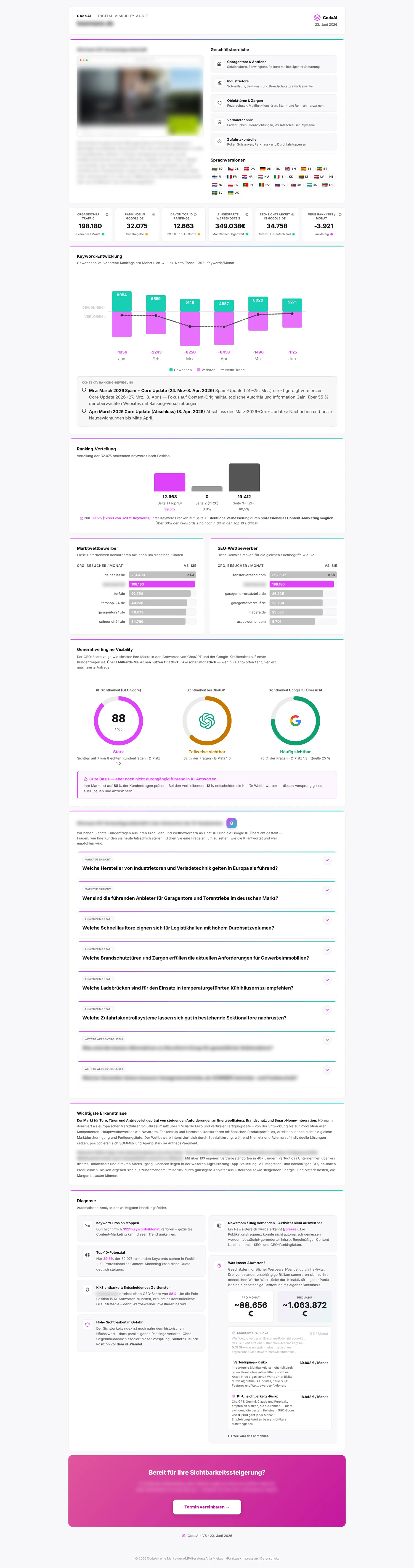
Real Digital Visibility Audit from the study dataset (anonymised)
Honesty before effect
An analysis is only as credible as the limits it names itself.
Citation
The aggregated figures may be quoted freely with attribution — in articles, talks, studies and presentations. Please always state the base (share of questions or share of companies) and note that this is not a random sample.
Each statement stands on its own and has its own link (the # symbol).
In 54.7% of the 3,592 buyer questions examined (1,965 questions), neither ChatGPT nor Google AI Overviews names the company concerned.
Source: CodaAI, AI Blind Test 2026 (n = 449 companies, June/July 2026), https://www.codaai.ai/en/study/ #
For 46.8% of the 449 companies examined (210), the AI systems recommend competitors by name while the company itself is missing from the majority of its buyer questions.
Source: CodaAI, AI Blind Test 2026 (n = 449 companies, June/July 2026), https://www.codaai.ai/en/study/ #
12.9% of the companies examined are not named in any of their eight buyer questions.
Source: CodaAI, AI Blind Test 2026 (n = 449 companies, June/July 2026), https://www.codaai.ai/en/study/ #
34.9% of the 361 companies with more than 100 top-10 rankings on Google are completely invisible in ChatGPT.
Source: CodaAI, AI Blind Test 2026 (n = 449 companies, June/July 2026), https://www.codaai.ai/en/study/ #
25.6% of the companies are not named even in the market-overview question about their own category.
Source: CodaAI, AI Blind Test 2026 (n = 449 companies, June/July 2026), https://www.codaai.ai/en/study/ #
Average visibility is 24.9% in ChatGPT and 39.4% in Google AI Overviews; 39.6% of companies are never named by ChatGPT, 15.1% never by Google AI Overviews.
Source: CodaAI, AI Blind Test 2026 (n = 449 companies, June/July 2026), https://www.codaai.ai/en/study/ #
For 39.0% of the companies, their own website is not cited as a source in any AI answer.
Source: CodaAI, AI Blind Test 2026 (n = 449 companies, June/July 2026), https://www.codaai.ai/en/study/ #
Where companies are named, their average position is 1.8; the company takes first place in 23.8% of all questions.
Source: CodaAI, AI Blind Test 2026 (n = 449 companies, June/July 2026), https://www.codaai.ai/en/study/ #
APA (7th edition)
Parrizas, O. (2026). AI Blind Test 2026 [KI-Blindtest Mittelstand 2026]: Analysis of 7,184 AI answers on 449 mid-sized companies in Germany (Version 1.0). CodaAI. https://www.codaai.ai/en/study/
Harvard
Parrizas, O. (2026) AI Blind Test 2026: Analysis of 7,184 AI answers on 449 mid-sized companies in Germany. Version 1.0, data as of June/July 2026. Gütersloh: CodaAI (AMP Beratung). Available at: https://www.codaai.ai/en/study/
Short credit for articles and slides
Source: CodaAI, AI Blind Test 2026 (n = 449 companies, June/July 2026), https://www.codaai.ai/en/study/
BibTeX
@techreport{parrizas2026aiblindtest,
  author      = {Parrizas, Oliver},
  title       = {AI Blind Test 2026: Analysis of 7,184 AI answers on 449 mid-sized companies in Germany},
  institution = {CodaAI (AMP Beratung)},
  address     = {G{\"u}tersloh},
  year        = {2026},
  month       = jul,
  note        = {Version 1.0, data as of June/July 2026},
  url         = {https://www.codaai.ai/en/study/}
} all aggregated values with units — to check the maths and build your own charts
the full analysis as plain text, also for AI assistants
Questions on the methodology: hi@codaai.ai. Publisher details for reference lists: Facts about CodaAI.
No, and we deliberately do not claim that it is. The 449 companies come from our own audit practice and are B2B-heavy. That said, our research suggests it is the most comprehensive analysis of its kind in the German-speaking market so far — smaller surveys (24 and 150 companies) arrive at similar results independently of us.
For each company, 8 qualified German questions were generated across three archetypes (market overview, use case, competitor comparison) — based on an automated analysis of the website, the industry and the competitive landscape, followed by a quality check. The question sets are frozen and can therefore be repeated for tracking over time.
ChatGPT (model answers without live web search) and Google AI Overviews (German localisation). Both interfaces were queried with identical questions; we recorded the brand mention, the position of that mention, the competitors named and whether the company website is cited as a source.
Yes. Using the same methodology we build an individual visibility audit for your company — with your real buyer questions, the actual AI answers and the competitors recommended in your place. Enter your domain at the top of this page.
We measured 449 companies in Germany, in German, on ChatGPT and Google AI Overviews. The mechanism behind it is not country-specific: AI systems answer from the same kinds of sources everywhere. The figures apply to the German market — the pattern travels, the evidence for that is still outstanding.
Not a sales pitch: we show you your AI visibility based on real buyer questions — and the two or three levers that work fastest for you.
Book a free intro call →