
A special-purpose machinery manufacturer in southern Germany wonders why he never appears in AI answers, although his website ranks well on Google. He has produced four explainer videos. They sit on his product page. None of them is on YouTube — and that is exactly where a substantial share of the systems deciding whether to name him go looking for their evidence.
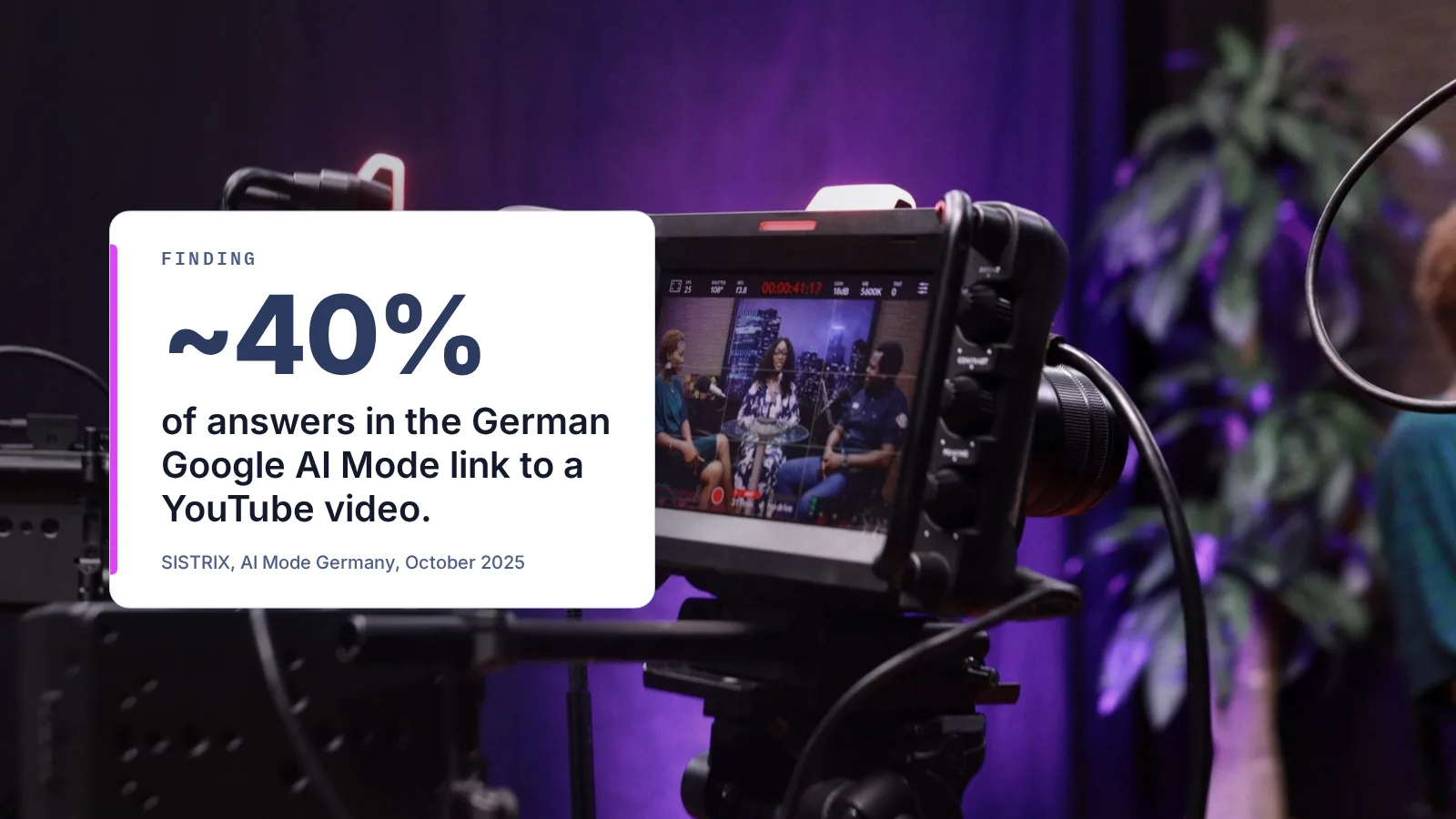
Around 40% of all answers in the German Google AI Mode contain a link to a YouTube video. That makes YouTube the most frequently cited source there — ahead of Wikipedia, ahead of any trade portal. SISTRIX measured this across many millions of answers in October 2025. This article sets out how far that finding carries, where its limits are, and what separates a citable video from an unusable one.
Fig. 1 · Share
YouTube is the most frequent single source in the German Google AI Mode
What AI systems find on YouTube that they do not find on your website
The difference is not the format. It is usability. A YouTube video hands an AI system three layers of text at once — title, description and a machine-readable transcript — on a domain whose structure these systems have known for years.
Ahrefs measured how close this connection is in December 2025. The study “Top Brand Visibility Factors in ChatGPT, AI Mode, and AI Overviews” examined more than 75,000 brands. Its finding, in the study’s own words: “YouTube mentions show the strongest correlation with AI visibility (~0.737), outperforming every other factor across ChatGPT, AI Mode, and AI Overviews.”
The definition behind it matters. Ahrefs counts a YouTube mention whenever a brand name appears in the title, the transcript or the description of a video. For comparison: the general “web mentions” metric in the same study does include YouTube, but explicitly only mentions in the video title — not in the transcript. It comes in at 0.656 to 0.709 depending on the platform. The metric that counts the spoken word sits above it.
From that follows a consequence that has little to do with video production and a great deal to do with care: what is said in your video is text, and it is treated as text. If your company name never comes up on camera because saying it out loud feels stilted, it will not be in the transcript either.
A second reason for the strength of the signal lies in the models’ own history. Ahrefs points to reporting by the New York Times that OpenAI trained GPT-4 on, among other things, more than a million hours of YouTube transcripts. These systems have not just discovered this material.
How large this channel actually is
This is where an assessment belongs that most articles on the subject leave out: YouTube is frequent, but not dominant.
Alongside its widely quoted detail findings, OtterlyAI’s YouTube Citation Study 2026 also gives the base figure: 5.54% of all observed citations came from social media and video platforms combined, and 31.8% of those went to YouTube. That works out at roughly 1.8% of all AI citations across six platforms.
The SISTRIX figure needs its context too: an AI Mode answer in Germany contains around 15 source links on average. “A YouTube link appears in 40% of answers” therefore does not mean YouTube supplies 40% of the evidence — it means that among fifteen sources it turns up particularly reliably.
So why does it still sit this far up the article? Because the distribution is extremely uneven. YouTube accounts for 36.6% of measured YouTube citations in Google AI Overviews, but 0.2% in Gemini. An average across all systems obscures precisely the decision at stake — namely, where your buyers actually search. More on that below.
One more figure belongs in this weighing up: according to SISTRIX measurements, only 42.2% of all AI Mode answers contain any brand reference at all. This is not about getting “more visibility”. It is about one of the few slots that are handed out at all.
What reach decides — and what it does not
Channel size apparently does not determine how often a video is cited. It does play a part in whether the video is in contention at all. That distinction is the core of the finding, and it is usually left out.
OtterlyAI analysed more than 100 million citation instances across six AI platforms within a thirty-day window. Two figures from it:
- 40.83% of cited videos had fewer than 1,000 views.
- The correlation between subscriber count and citation frequency is r = −0.03, effectively zero. Views (−0.03), likes (−0.02), title length (0.02) and video length (0.02) are all in the same range.
The only metadata factor with a meaningful relationship was the length of the video description (r = 0.31), followed by hashtags in the description (r = 0.20).
Now the limitation Otterly states itself, and which bounds the finding: the dataset contains only videos that were already cited. The study records in its own words that its results therefore explain “repeated citation behavior, not initial eligibility” — citation frequency, then, but not what puts a video into the pool of candidates in the first place. On reach it says accordingly that it does not drive citation intensity, “but it expands the pool of possible citation candidates”.
Ahrefs also phrases this more carefully than it is usually reproduced: brands are not at a significant disadvantage when they are mentioned in low-view videos — “so long as they’re mentioned widely”. The breadth of mentions still matters; the size of the individual channel does not.
For a mid-sized company that means, soberly: a channel with 300 subscribers rules nothing out. It also does not remove the need for people to talk about you — on YouTube and elsewhere. Anyone who uploads a single video and waits for an effect has misread the finding.
A methodological note, so the figures are not lined up wrongly: Ahrefs works with Spearman rank correlations at brand level, Otterly with Pearson correlations at video level. The values 0.737 and 0.31 are not on the same scale and are not directly comparable. And no market or language is stated for the Otterly study — we apply its findings on how a video should be built to the German market without the study covering that.
Not every AI uses YouTube to the same degree
If your priority is being named in ChatGPT, YouTube is not where you should start. That is the most uncomfortable statement in this article, and it follows directly from the data.
OtterlyAI distributes the measured YouTube citations as follows:
| AI system | Share of all measured YouTube citations |
|---|---|
| Perplexity | 38.7% |
| Google AI Overviews | 36.6% |
| Google AI Mode | 19.6% |
| ChatGPT | 4.4% |
| Microsoft Copilot | 0.5% |
| Gemini | 0.2% |
Around 95% of measured YouTube citations therefore fall to Perplexity and the two Google surfaces. ChatGPT — in German B2B, in our observation, the most widely used system — accounts for a single-digit share.
That does not make video useless for ChatGPT: the Ahrefs correlation applies there too, and according to Ahrefs YouTube is the sixth most cited domain in ChatGPT. The route of the effect is simply different — via training material and the mention itself, rather than a link in the answer.
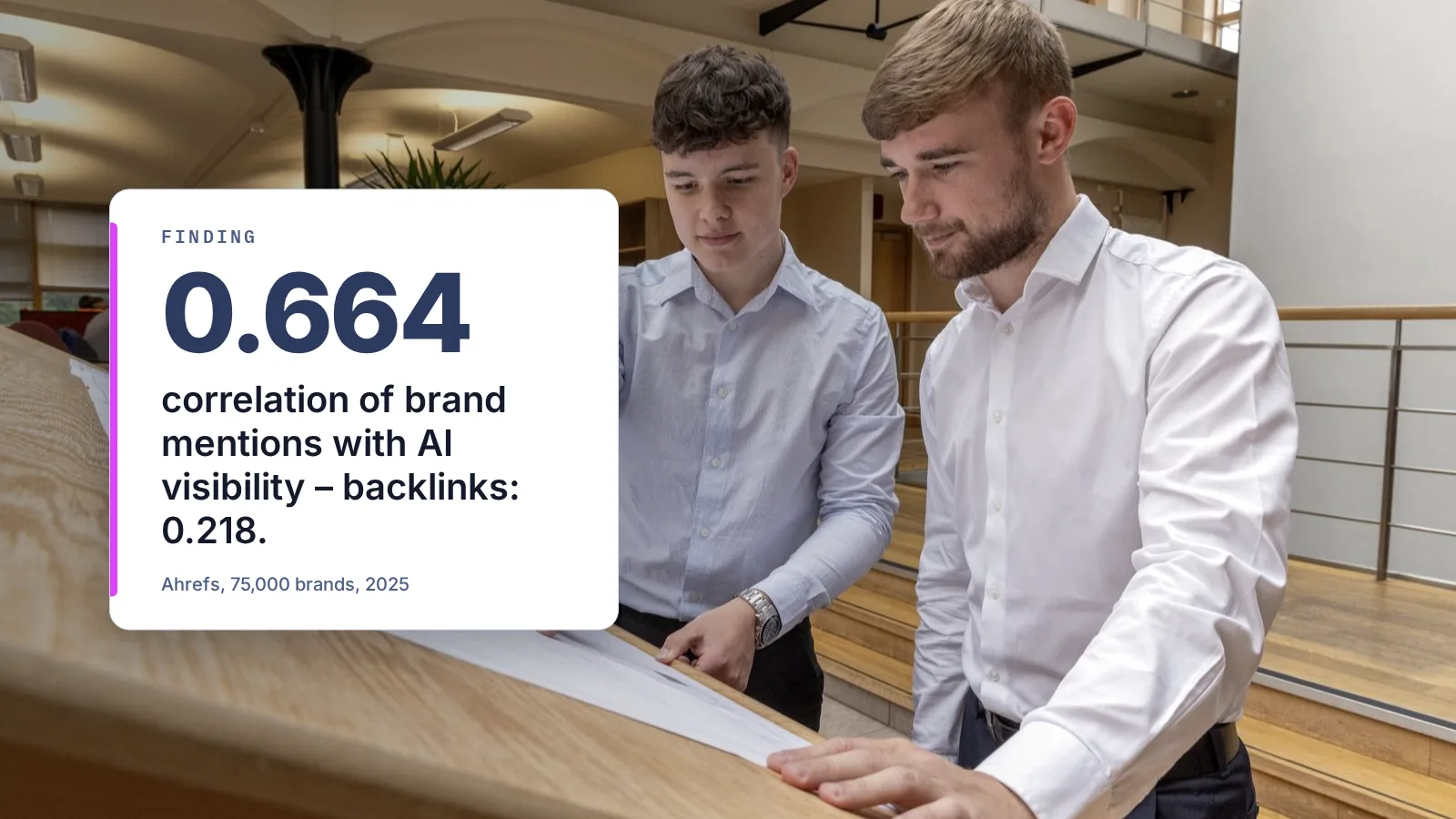
It does mean, though, that sequence matters. Anyone working with a limited budget who knows their audience researches in ChatGPT will get more out of expert articles and mentions on third-party sites. In Ahrefs’ study “An Analysis of AI Overview Brand Visibility Factors” from May 2025 — likewise across 75,000 brands — branded web mentions came in at r = 0.664, backlinks at r = 0.218.
How to find out which system your buyers use
This question cannot be answered from market figures, because it depends on the sector. Three routes lead to a reliable answer, and all three cost nothing but discipline.
Ask in the first call. One line in the conversation guide is enough: “How did you come across us — and did you ask an AI beforehand?” After twenty conversations you will have a pattern. It is untidy in statistical terms and still more informative than any industry study, because these are your customers.
Check your analytics, with tempered expectations. Referrals from chatgpt.com, perplexity.ai or gemini.google.com show up there as referrers. The volumes are small, and Google AI Overviews do not appear as a separate source at all, because the click is counted as an ordinary Google referral. A referral you can see is a signal; one you cannot see is not counter-evidence.
Ask the questions yourself. Take the five questions your sales team hears most often and put them into ChatGPT and into Google search with AI Overviews. Note which providers are named and which sources the systems cite. Repeat this in four weeks with the identical wording — different questions produce different answers and make the comparison worthless.
The third route quickly reveals whether YouTube appears as a source in your subject area at all. If the answers show nothing but trade portals and manufacturer sites, video is not your next step.
How to tell whether a video is usable
Four characteristics can be derived from the available measurements. None of them is a question of production quality — all four are questions of preparation.
1. Long-form for citability, short-form for the route to it
94% of AI citations in the OtterlyAI analysis went to long-form videos, not Shorts. The most frequently cited length was 10 to 20 minutes (32.1%), then 5 to 10 minutes (26.1%).
The reason is not hard to see: an AI system is looking for a verifiable statement, not for attention. A video that answers a question in full delivers more citable substance than three clips that skirt it. Anyone producing for citability should not keep cutting until nothing is left.
Concluding from this that short clips are worthless would be the wrong reading, though — they simply have a different job. Two formats, two jobs:
| Short-form (30–60 seconds) | Long-form (5–20 minutes) | |
|---|---|---|
| Where | LinkedIn, Instagram, TikTok, YouTube Shorts | YouTube |
| Job | Create attention where your audience is scrolling, and lead to the article | Answer one question in full, in a machine-readable way |
| Measure of success | Reach, clicks through to the article | Citations in AI answers |
The short clip does not sell the product, it sells the article. It takes a single statement from the expert article — a figure, a comparison, an objection — and leads back to the page that holds the full answer. That page is the central point of reference: it belongs to you, it stays reachable, and it is what AI systems ultimately read. A clip that points nowhere is wasted; one that leads to a sourced article works for both channels.
Where honesty is required is in attribution. That more readers of an expert article indirectly produce more mentions, and therefore better AI visibility, is plausible — it has not been measured. The short clip justifies itself through reach and clicks, not through citations. Anyone who mixes the two is selling an effect they cannot evidence.
2. One question, not a product overview
The most common mistake is not a technical one. It is in the topic.
- Weak: “Our new X7 series at a glance” — answers no question anybody asks.
- Workable: “Chain conveyor or roller track: when each one pays off” — answers exactly the question a buyer puts to an AI.
The practical test: would somebody type this phrasing into a search box or into ChatGPT? If not, the video will not be cited as an answer to that question either. The best topics therefore sit with your sales team — they are the questions that come up in every second customer conversation.
3. Chapters and time markers
Only 31% of cited videos had time markers at all — Otterly counts both timestamped citations and chapter-style timestamps in the description. Of the videos that had them, 78% were cited more than once, usually across two to five different sections. Otterly describes the mechanism this way: time markers work like subheadings and allow citation at section level rather than at video level.
Worth noting: timestamped citations occurred exclusively on the Google surfaces — 73% in AI Overviews, 27% in AI Mode. None was measured in ChatGPT, Copilot, Gemini or Perplexity.
In practice this means one chapter marker per sub-question, named like a subheading.
00:00 What this is about
01:24 Chain conveyor: design and limits
04:10 Roller track: design and limits
07:35 When each system pays off
11:02 Three questions before you decide
Not: “Intro”, “Part 1”, “Part 2”. Those labels carry no information anybody could cite.
Fig. 2 · Before / after
Chapter markers that can be cited
Not usable
00:00 Intro · 02:10 Part 1 · 06:45 Part 2 · 11:30 Summary
No marker carries a statement that could be cited
Usable
00:00 What this is about · 01:24 Chain conveyors: design and limits · 04:10 Roller conveyors: design and limits · 07:35 When each system pays off
Each marker answers a sub-question. 78% of videos with timestamps were cited more than once.
4. Description and transcript
Description length is the only metadata factor with a meaningful correlation (r = 0.31). This is not a call for walls of text, but for completeness: what it is about, who it is for, which question it answers, who is speaking — and the company name written out, not abbreviated.
On transcripts, honesty is in order: there is no study showing that a corrected transcript produces more citations than automatically generated subtitles. Anyone quoting you a percentage for that has not measured it.
What is evidenced is only the indirect route: the metric that includes transcript mentions correlates more strongly than the one covering only title and description. And automatic speech recognition reliably fails on exactly the words that matter — product names, technical terms, company names. “Chain conveyor” becomes “chain conveyer”, a company name becomes an everyday word. A reviewed transcript is therefore a reasoned precaution, not an evidenced improvement — and we do not describe it as one here.
How this becomes a building block rather than a one-off
A video that is produced but not published in a usable form is worth nothing for AI visibility. That is why publishing on YouTube is a building block in its own right for us, and not a footnote to production. Where video sits alongside readability, brand mentions and comparison lists is set out in Getting recommended by ChatGPT as a supplier.
It belongs to the second visibility tier, “Recommended” — the tier that answers the question: am I present where the AI sources its evidence? The first tier settles beforehand whether AI systems can read your website at all. That order is not negotiable: what cannot be read will not be cited.
In practice both formats come out of one expert article: the short clips for the social channels that lead to the article, and — where the topic carries it — the longer version for YouTube that answers the question in full. In both cases the article remains the point of reference everything points to.
Equally important is what the building block does not cover. We publish the videos created during the engagement, with title, chapters and transcript. Reworking an existing channel and older videos is a project of its own with its own objectives, and is not part of the building block.
The process behind it is unspectacular, and reliable for exactly that reason:
- Question first. Which three questions does your sales team hear in every second conversation? Those are the video topics — not the product launch nobody is searching for.
- Answer in full. One topic, one video, as long as the question requires.
- Prepare it. A chapter marker per sub-question, a thorough description, a reviewed transcript — check company and product names.
- Interlock them. The video belongs on the page it fits, and the text belongs beneath the video. Each format supports the other, and the page gains dwell time.
- Measure. The same eight buyer questions, every month, in the same systems. Without measurement, any statement about effect is an assertion.
What video does not do
Every figure in this article is a correlation. Ahrefs says so itself: “The usual disclaimer applies: correlation isn’t causation.” Whether YouTube mentions cause a brand to be named in AI answers, or whether both are expressions of the same brand strength, cannot be settled with this data.
One objection is particularly close to hand: YouTube belongs to Google, and the Google surfaces favour their own platform. That explains part of the effect — but not all of it, because the correlation is almost as high in ChatGPT, where no corporate interest applies.
From this follows what we do not promise elsewhere either: there is no bookable placement in an AI system. The same question can be answered differently tomorrow. What is defensible is a statement about the trend, not about a single day — which is why we measure monthly with a frozen set of questions, including when the line stays flat.
And video does not deliver meaningful traffic. Referrals from AI systems account for around one per cent of traffic. The honest argument is a different one: the decision is made before anybody clicks. If you do not appear in the answer, you are not on the shortlist that gets checked afterwards.
Conclusion: a channel where care counts for more than budget
For a field this young, the evidence is unusually consistent. YouTube is the most frequently linked source in the German AI Mode. YouTube mentions correlate more strongly with being named in AI answers than any other factor examined. Channel size does not decide citation frequency. And time markers — the characteristic with the clearest effect on repeat citations — are missing from seven out of ten cited videos.
At the same time YouTube is only one source among many: roughly 1.8% of all measured AI citations, and far less present in ChatGPT than on the Google surfaces. Anyone deriving a video strategy from this without first checking where their own buyers search is optimising on a hunch.
So the first step is not the camera. It is the question of whether your company appears in those answers today at all — and who is named instead.
Would you like to see what AI systems currently say about your company? We put eight real buyer questions from your sector to ChatGPT and Google AI Overviews and show you which of them leave your name out — and which competitor is recommended instead. Request your free audit.
The terms behind this are in the GEO glossary: YouTube presence, grounding, entity, mention. How video works alongside brand mentions and comparison lists is covered in brand mentions on third-party sites and comparison articles and vendor lists.