
Ask ChatGPT which suppliers are worth considering for a particular job and you do not get a list of results but three to five names. Only those companies make the buyer’s longlist. ChatGPT names the companies it either knows from training or finds confirmed in several independent sources during a web search. Both can be influenced, but not with the tools that were enough for Google.
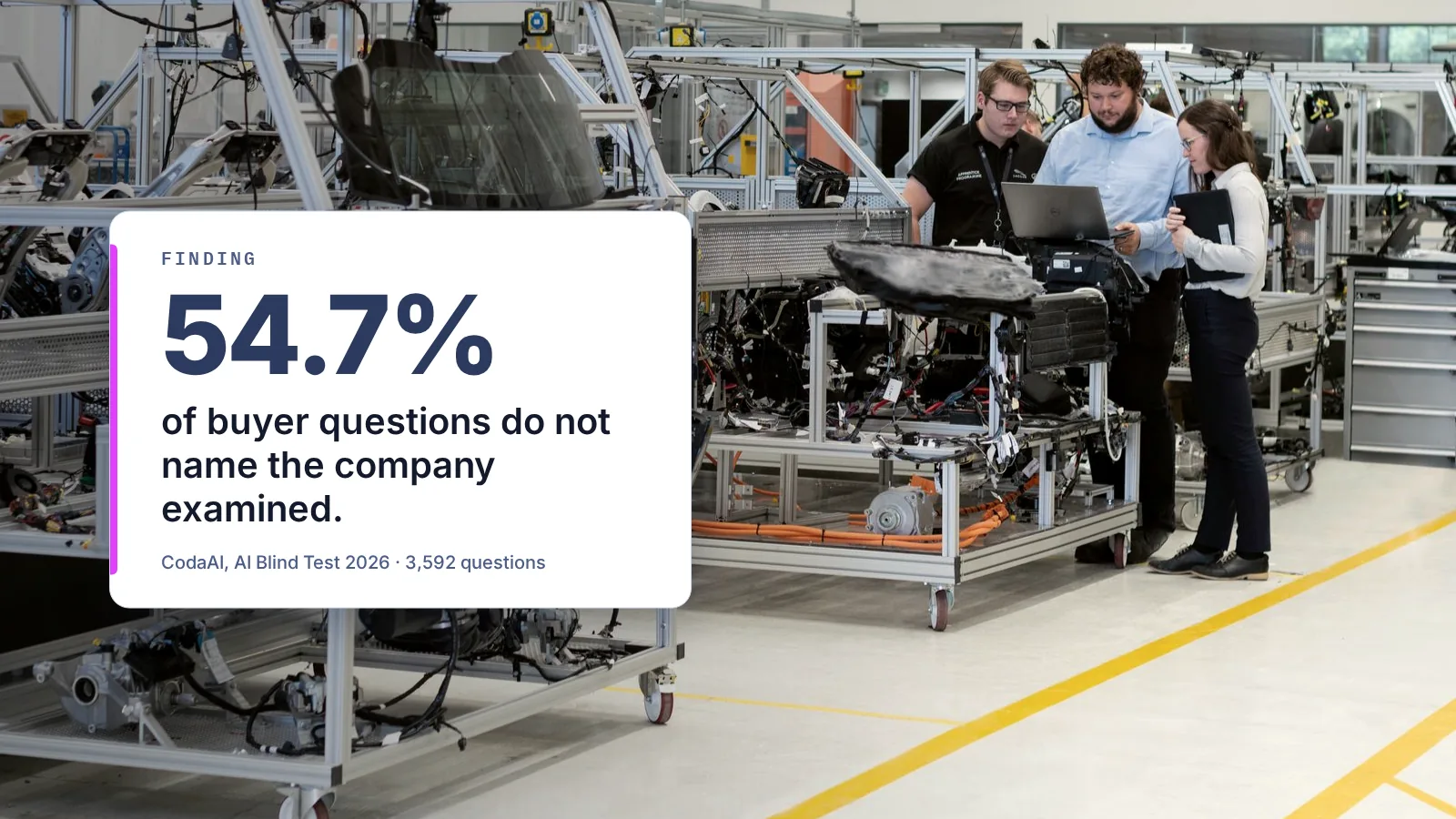
In our study of 449 mid-sized companies in Germany, 54.7% of 3,592 buyer questions went without a mention of the company examined. For 46.8% of the companies, ChatGPT and Google AI Overviews recommended competitors by name instead.
Fig. 1 · Share
More than every second buyer question ends without the company examined
How does ChatGPT decide which suppliers to name?
ChatGPT decides in two steps: first it assembles a list of candidates, then it picks the names for which it has the most consistent evidence. The candidates come from two sources.
The first is model knowledge – everything the model read during training. Companies described often and consistently there belong to its fixed repertoire. Companies that have renamed, repositioned or spun off since the training cut-off are missing.
The second is web search. ChatGPT triggers it when it is not sure of the answer. The question is split into several sub-questions, pages are fetched for each, and only individual passages make it into the answer. For web search, the Bing index matters most: in an analysis by Seer Interactive, 87% of SearchGPT citations matched Bing’s organic top results, but only 56% matched Google’s (more in the article on Bing).
Fig. 2 · Process
How ChatGPT arrives at its list of suppliers
- 1Buyer question“Which suppliers for … lead the market in Europe?”
- 2Model knowledge or web searchWhat the model knows – or what the search index (mainly Bing) returns
- 3Candidate poolEvery company that appears in the sources
- 4Checking the evidenceCompanies described the same way in several independent sources stay This is where companies drop out that only appear on their own website
- 5AnswerThree to five names, often with source links
The full mechanics with every intermediate step are in the GEO optimization guide.
Why is a good Google ranking not enough?
A good Google ranking is not enough because ChatGPT often does not search at all and, when it does, uses a different index. The study shows this clearly: 34.9% of the 361 companies with more than 100 top-10 rankings on Google are completely invisible in ChatGPT. We call this the SEO paradox.
An example from the survey: a mechanical engineering firm for factory automation with around 640 top-10 rankings was not named in any of its eight buyer questions. The most frequently named competitor appeared seven times. The company does not lack relevance; it lacks mentions on other sites, which the AI uses to build its candidate list.
On top of that, the systems differ. The same questions produced an average visibility of 24.9% in ChatGPT and 39.4% in Google AI Overviews. 39.6% of companies were never named by ChatGPT. We deliberately queried ChatGPT without web search – the figure measures what the model knows on its own.
Which measures demonstrably work?
Five measures demonstrably work, and they build on each other. Sorted in the order in which they should be tackled:
1. Make your own pages readable for AI crawlers
Readability is the precondition for everything else. No crawler from OpenAI, Anthropic, Perplexity, Meta or ByteDance executes JavaScript (Vercel and MERJ, December 2024). Service descriptions that only come into being in the browser or only sit in PDFs do not exist for these systems. That also means not locking out the AI crawlers in robots.txt.
2. Describe the company the same way everywhere
Consistency is what AI checks when it weighs the evidence. Among the 1,000 most-cited pages in ChatGPT, 23.8% are home and landing pages (Ahrefs, October 2025) – your own home page is one of the few sources a company fully controls. Company name, category and service description should read the same there, in directories and on profiles. More in the glossary under consistent brand description.
3. Get mentioned on third-party sites
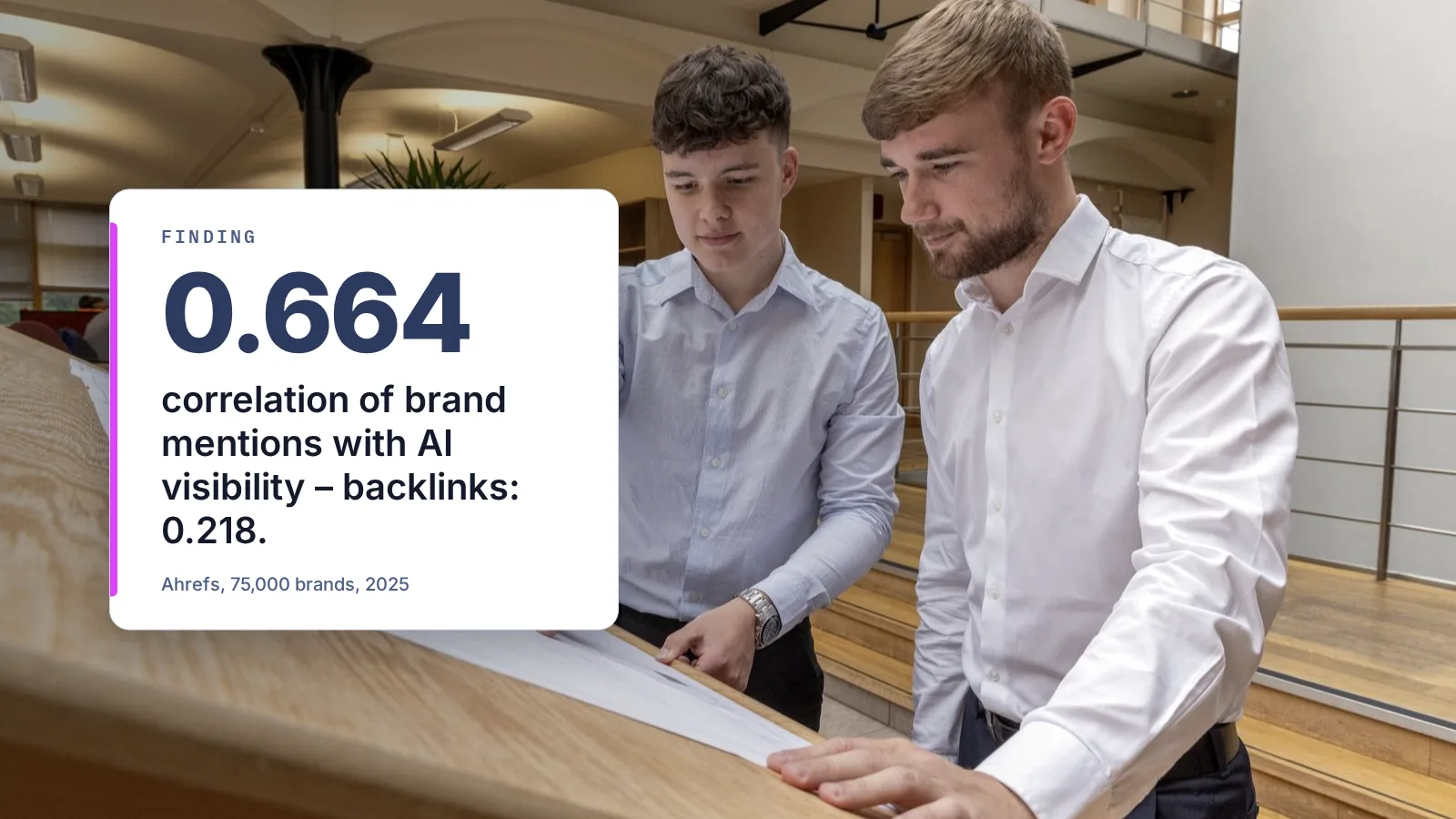
Mentions on other sites are the strongest single factor measured. Ahrefs found for 75,000 brands that brand mentions on the web correlate with being named in Google AI Overviews at 0.664, backlinks only at 0.218 (Ahrefs, 2025). What counts is the mention in the right subject context, not the link. Correlation is not causation, and the sample consists of large brands.
4. Appear in your industry’s comparison lists
Comparison lists are the source cited most often in purchase decisions. In an analysis of around 1,260 B2B purchase prompts, 70.8% of all citations pointed to pages with “best”, “top” or “leading” in the title (Overthink Group, July 2026). The data comes from the US software market, but the direction matches what we observe in German B2B.
5. Write content that can be cited
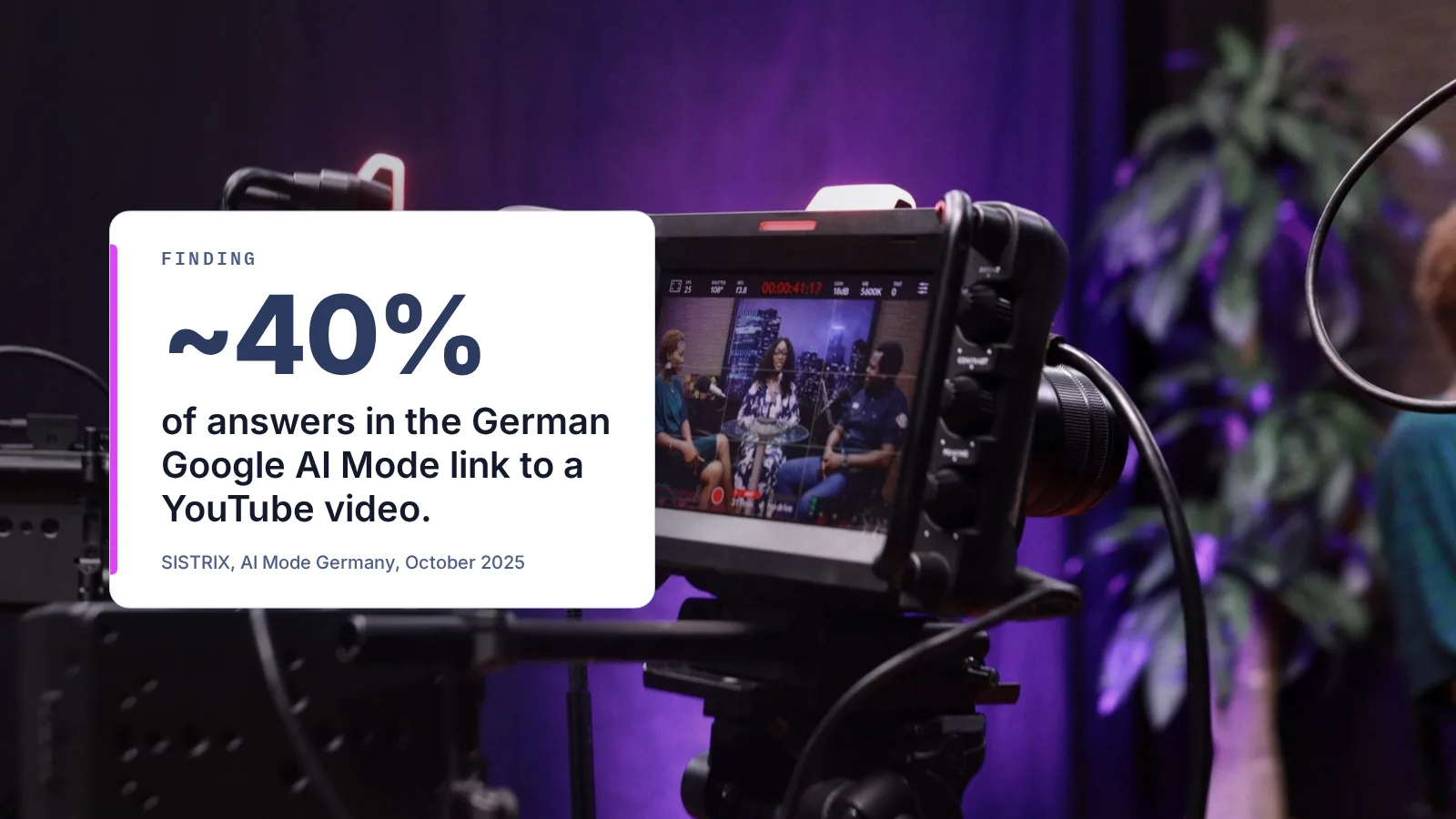
Citable content decides whether your own page is linked as a source. The Princeton study on Generative Engine Optimization (Aggarwal et al., KDD 2024) tested nine text measures on 10,000 queries. The strongest were verbatim quotations (+41%), statistics (+34%) and source references (+28%) – exactly what a model cannot generate itself. Keyword stuffing brought no gain. One format that is often overlooked is expert videos on YouTube.
What does not work?
Not every measure sold as GEO has evidence behind it. We explicitly advise against four of them:
- llms.txt as a lever. 97% of the files examined were never fetched by an AI crawler (Ahrefs, 137,210 domains). The file does no harm, but it does not replace any of the measures above.
- Placement guarantees. Nobody can promise a mention in ChatGPT, because nobody controls the answers.
- Planting mentions in forums. In niche B2B purchase prompts, Reddit accounted for 1.4% of citations (Overthink Group). On top of that comes the risk of being spotted as self-promotion.
- Stuffing texts with search terms. In the Princeton study this brought no gain, and on Perplexity it even caused a loss.
The full list with evidence is on the services page under “Six things we deliberately do not offer”.
How can you check whether ChatGPT names your company?
A mention can only be checked as a share across many runs, not with a single question. AI answers vary widely: in a SparkToro study with 2,961 runs, the same list of suppliers appeared twice in fewer than one in a hundred cases, the same order in fewer than one in a thousand (Rand Fishkin, January 2026). A screenshot therefore proves neither that you are named nor that you are missing.
What holds up is a fixed prompt set: eight to twelve questions your buyers really ask, put to ChatGPT and Google AI Overviews several times. That gives you the mention rate – the share of answers in which you appear – and the list of competitors named instead. Recording this before the first measure gives you a baseline measurement, so you can prove progress later. What such a measurement looks like in practice is shown in our analysis of 7,184 AI answers.
Where should you start?
Start with an honest assessment of where you stand, not with a measure. The order that follows from the evidence:
- Measure. Put five buyer questions to ChatGPT and Google AI Overviews, three times each, and note who is named.
- Become readable. Check whether your most important service pages are readable without JavaScript and whether AI crawlers are allowed.
- Become consistent. Align company name, category and service description on your home page, profiles and directories.
- Get mentioned. Find the sources AI cites for your questions and be present there with substance – in trade media, comparison lists and industry directories.
The order is no accident: mentions on third-party sites only work if AI finds them confirmed on your own website. Starting with step four means building without a foundation.