
A potential customer types a question into ChatGPT today, is recommended three suppliers and contacts exactly those three — and your company never hears about it. There is no drop in traffic, no lost ranking position, no line in your analytics dashboard. This article shows what AI visibility means in practice, what an analysis of 7,184 AI answers covering 449 mid-sized companies revealed, which five levers actually work according to current research — and how CodaAI takes over the content side once you know where you stand.
Fig. 1 · Key figure
The same questions, two systems – two different results
What AI visibility really means in practice
AI visibility measures whether a company appears in an AI system’s answer when a potential customer asks for a solution — and in which position. It is therefore not an evolution of SEO but a discipline of its own, with different rules.
The decisive difference lies in the size of the result set. A Google search delivers ten organic results on page 1, plus ads, maps and other modules. A user can scroll, compare and open several tabs. An AI answer, by contrast, typically names three to five suppliers — in running text, with no competitors in view, in the authoritative tone of a recommendation. There is no position 8 to fall back on. You are either mentioned or not.
That fundamentally changes the economics of visibility. According to YouGov (survey April/May 2026, 1,005 respondents in Germany), 68% of Germans count as “AI searchers” — people who start a new search via an AI assistant at least once a day. That puts Germany well ahead of the USA (48%) and the UK (54%). According to the same study, AI assistants are now the second most frequent source of information among German online searchers.
At the same time, the study shows an uncomfortable figure for anyone hoping for downstream traffic: only 23% of respondents go on to click the sources the AI provides. 21% end their research entirely with the AI answer. For companies, this means most of this research leaves no trace in their own analytics. Visibility or invisibility in AI answers is a blind spot by design.
The AI answer is the starting point — not the end point
A common misconception is that AI systems replace the purchasing decision. They do not. In “The State Of Business Buying, 2026”, Forrester paints a more nuanced picture: generative AI searches are the starting point of B2B research, but decision-makers increasingly rely on internal and external networks to validate their decisions. The reason is mistrust — according to Forrester’s findings, AI answers often provide incomplete or unreliable information, and buyers compensate by validating with trusted sources.
According to Forrester, the typical B2B purchasing decision now involves 13 internal stakeholders and nine external influencers; procurement has a say in 53% of cycles and gets involved early.
For AI visibility, this nuance is not a reason to relax but a reason for more urgency. If the AI answer is the starting point, it determines who gets into the validation loop in the first place. A supplier that does not appear in the first answer is not checked with colleagues, not discussed in the buying centre and not included in the business case. It does not fail — it never features at all.
Gartner confirms the direction: in a survey of 646 B2B buyers, 67% prefer a buying process without contact with a sales rep, and 45% used AI in a recent purchase. The shortlist is therefore decided at a stage when your sales team is not even at the table.
The blind spot in most AI visibility strategies
Most companies working on AI visibility address exactly one of two dimensions. They take care of the technical side: opening robots.txt to GPTBot and ClaudeBot, creating llms.txt, adding Schema.org markup, reducing server response times. That is right and necessary — but it only ensures that AI systems are allowed and able to retrieve your content at all.
Whether they then also cite that content is decided by something else: what it says. Technical retrievability gets you through the door — GEO-optimised content is what earns you a place. Both have to be right, and in practice the second half is almost always underestimated. A cleanly delivered marketing text without facts, structure or sources is worthless to a language model: it finds nothing in it that it could use in an answer.
What 7,184 AI answers reveal about mid-sized companies in Germany
To measure the scale of the problem rather than estimate it, we systematically tested 449 mid-sized companies in Germany. For each company, eight realistic buyer questions about its own range of products and services were formulated and put to two systems: ChatGPT (without live web search enabled, to measure structural model knowledge) and Google AI Overviews with German localisation. The result: 3,592 questions, 7,184 documented AI answers, data as of June/July 2026.
The key findings of the AI Blind Test 2026:
| Finding | Value | Basis |
|---|---|---|
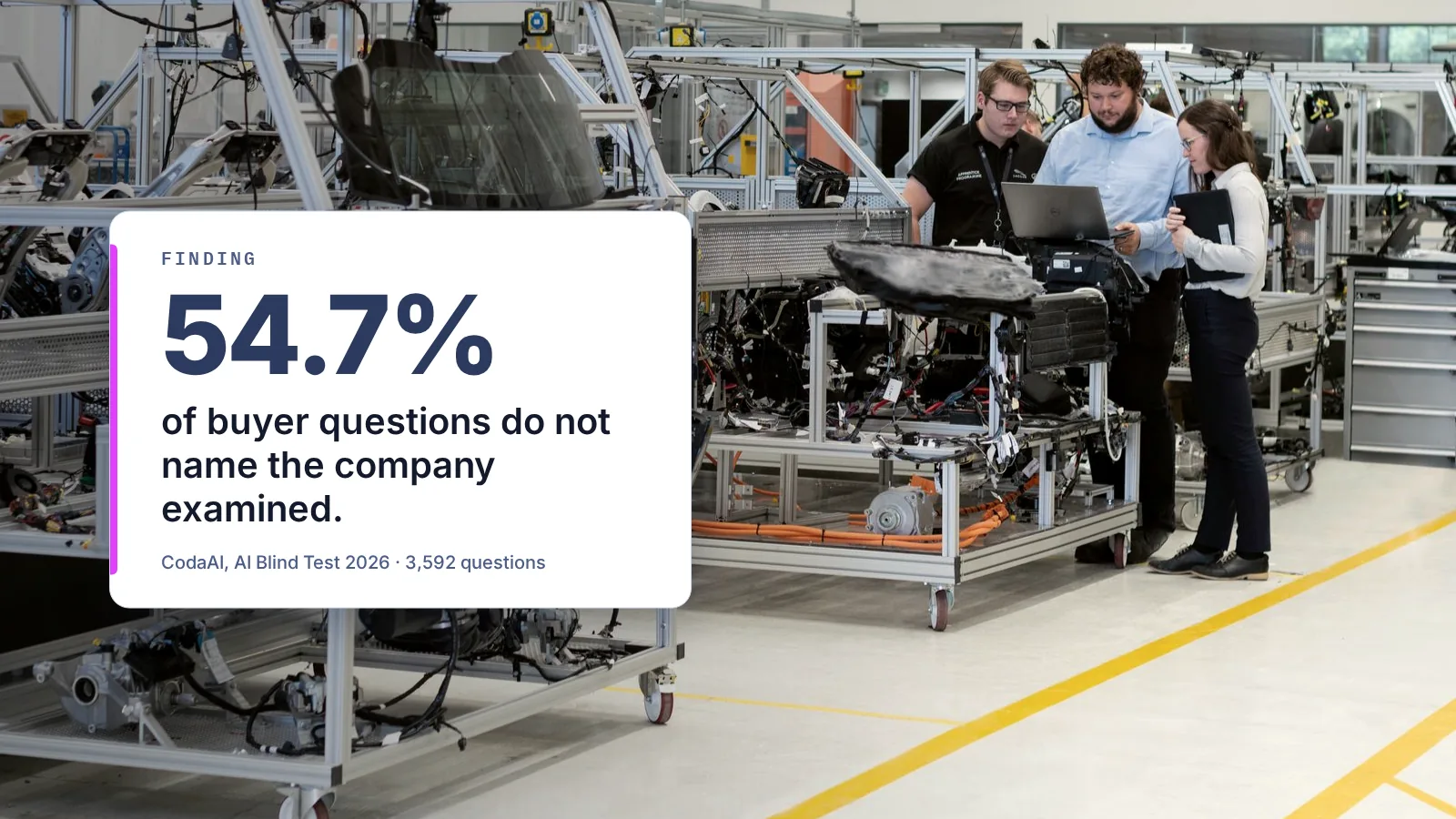
| Questions without a mention of the company | 54.7% | 1,965 of 3,592 questions |
| Companies for which competitors are recommended by name | 46.8% | 210 of 449 companies |
| Completely replaced (0 mentions across 8 questions) | 12.9% | 449 companies |
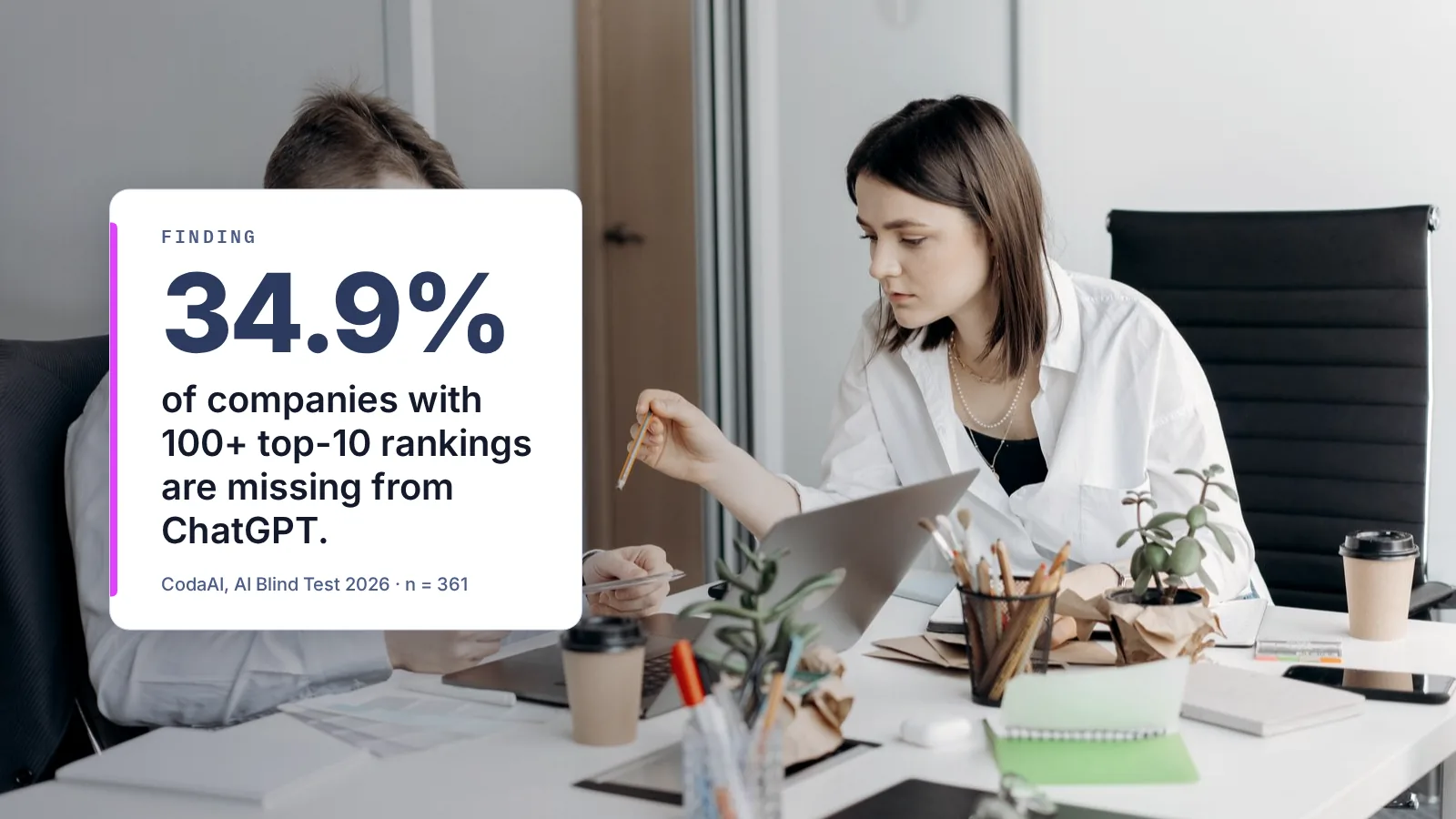
| Invisible despite strong Google rankings | 34.9% | 361 companies with > 100 top-10 rankings |
| Not named for their own category question | 26% | 449 companies |
| Own website not cited as a source in any answer | 39% | 449 companies |
The last point deserves attention: for almost four in ten companies, their own website is not used as a source in a single answer. These companies are described by AI systems solely on the basis of third-party sources — industry portals, press articles, directories, competitor comparisons. The company’s view of itself no longer plays any role in how the company is described.
Putting this in context also means stating what this analysis is not: the 449 companies come from our own audit practice and are weighted towards B2B — this is not a random sample. The results apply to the companies examined, not to “mid-sized companies in Germany” as a whole. Two smaller independent surveys by third parties (24 and 150 companies respectively, spring 2026) arrive at similar orders of magnitude, which supports the direction but does not replace representativeness. These limitations are fully documented — anyone working with figures should state their limits too.
The SEO paradox: why good rankings do not protect you
The most surprising finding is also the most costly: 361 of the companies examined have more than 100 top-10 rankings on Google. One in three of them (34.9%) is nevertheless completely invisible in ChatGPT.
Until recently, that was a finding without an explanation. Now there is one — and it comes from the largest public correlation analysis on the subject to date. Ahrefs examined 75,000 brands and measured which factors are associated with mentions in Google AI Overviews (Spearman correlation):
| Factor | Correlation |
|---|---|
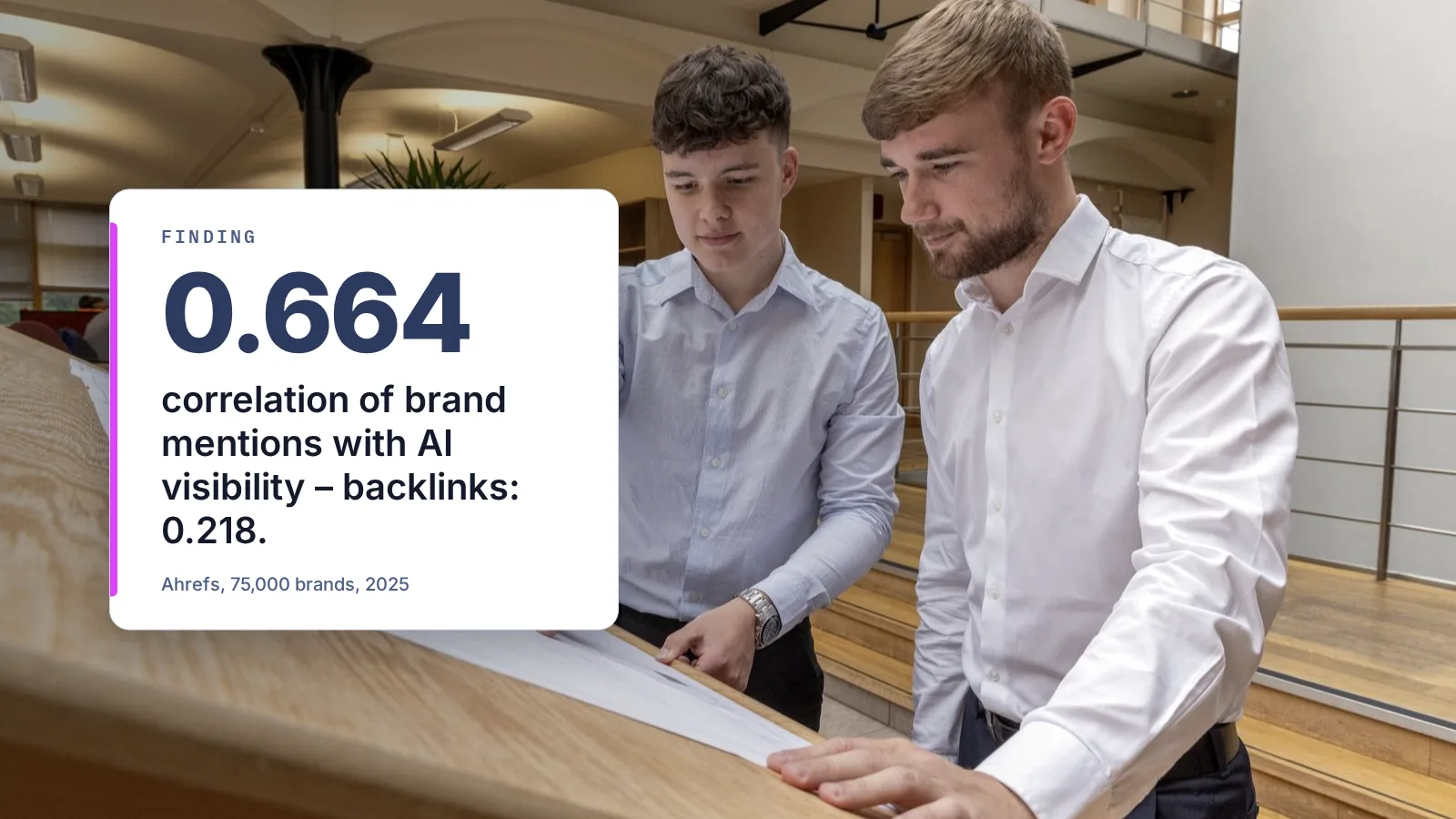
| Brand mentions on the web (linked or unlinked) | 0.664 |
| Branded anchor texts | 0.527 |
| Branded search volume | 0.392 |
| Domain Rating | 0.326 |
| Referring domains | 0.295 |
| Number of backlinks | 0.218 |
The three strongest factors all lie outside the company’s own website. Brand mentions correlate around three times more strongly with AI mentions than backlinks do. An independent study by Seer Interactive (January 2025, 10,000 questions via GPT-4o) found the same pattern: backlinks proved almost neutral (around 0.10), domain rank weak (0.25) — the strongest correlation there was shown by Google rankings on page 1 (around 0.65).
The effect becomes even clearer in quartiles: brands in the top quarter by web mentions achieve a median of 169 mentions in AI Overviews. The next quarter down reaches 14. The bottom two quarters sit at 0 to 3. Ahrefs’ conclusion: anyone in the lower half for web mentions is practically invisible to AI systems. 26% of all brands examined had no mention at all.
Two caveats belong here, and Ahrefs names them itself: correlation is not causation, and all measured values fall in the moderate to weak range on the Spearman scale. But the direction is consistent across several independent datasets — and it explains our own finding. A manufacturer can rank on page 1 for 800 keywords: if its name appears on the web only on its own domain in product data sheets, and never in an explanatory context alongside its category, the model lacks the association. Rankings come from optimising individual pages. AI mentions come from the number and quality of the contexts in which a name appears on the web.
ChatGPT and Google AI Overviews are two different playing fields
The same questions, two systems, two realities. In our analysis, average visibility was 24.9% in ChatGPT and 39.4% in Google AI Overviews. 39.6% of companies were never named by ChatGPT — in Google AI Overviews, the figure was 15.1%.
The explanation is structural: in this test, ChatGPT answered from training data. A company missing there is missing at a deep level and can hardly be corrected in the short term, because a new landing page does not change the training material of a model that has already been trained. Google AI Overviews draw more heavily on the live index — here, content and technical measures take effect much faster.
On top of that, “AI search” has long ceased to be a single channel. Between September 2024 and March 2026, Similarweb measured visit growth of around 84% for ChatGPT — but roughly ninefold for Gemini and around +770% for Claude. Optimisation that targets only one system ignores a growing part of the market.
In practice, this leads to a clear prioritisation: Google AI Overviews are the fast lever, ChatGPT the slow one. Anyone tackling both at once should expect weeks for Google and quarters for ChatGPT — and in the meantime work above all on mentions in third-party sources, because that is the channel through which model knowledge forms over the long term.
Why the effect does not show up in any analytics
The most common question from management is: “If this is so important, why do we see nothing of it in our figures?” The answer has three parts, and all three can be backed up.
First: AI answers rarely cite sources. According to Similarweb, only 2.8% of all ChatGPT answers contained any source references in August 2025 — in January 2025 the figure was 0.6%. The trend is rising clearly, but the absolute level is low. A mention without a citation produces no click, but it can very well produce a purchasing decision.
Second: the click arrives without an origin. Anyone who types the company address straight into the browser after researching in a chat appears in analytics as direct traffic. Part of what is recorded as “Direct” is in fact AI visibility. This is reinforced by a shift in behaviour: since ChatGPT began showing clickable brand links directly in answers on 7 May 2026, referrals rose by 157.7% week on week according to Similarweb — and visits to homepages by as much as 354.7%. The homepage share of all ChatGPT referrals jumped from 26–32% to around 60%.
This shift is strategically relevant: AI systems increasingly behave like a brand discovery channel and less like a search engine. Users do not land on the relevant subpage but at the company’s front door. A company that gives no clear, machine- and human-readable answer there to “What does this firm do?” loses out at the very moment the AI has just recommended it.
Third: when clicks do come, they are the right ones. According to the same Similarweb data (April/May 2026), ChatGPT referral traffic converts at 7.1% — the second best of all channels measured, just behind paid search (7.8%) and ahead of direct traffic, organic search, social, email and display. Fewer visitors, but further along in their decision.
A note on rigour: much higher figures circulate for the conversion rate of AI traffic (around 16% compared with 2.3% from organic search). These come from older analyses and are often passed on via secondary sources. We deliberately use the current value of 7.1% here, which can be verified directly with the primary source.
Five levers that create AI visibility in practice
There is no single switch for AI visibility. What consistently works in our audits, and can also be supported by external research, are five levers — ordered by impact per effort. A compact, evidence-ranked version for the question of how to get named in ChatGPT as a supplier can be found in the article Getting Recommended by ChatGPT as a Supplier.
1. Entity clarity: say what you do — in your market’s words
Language models need to be able to assign your company to a category. Among mid-sized companies, this often fails because of their own language: “system solutions for demanding applications” works for a person in a sales conversation, but for a model it is empty. There is no category this sentence can be assigned to.
In practice, this means every key page must state in clear, categorical language what the company manufactures or provides, for which industries, in which regions, with which standards and certifications. Not as keyword stuffing, but as a factual description — the same one a buyer would use. In addition, the website needs a clean Organization schema with a consistent name, address and description, and these details should be identical everywhere on the web.
The homepage deserves particular attention. Since AI systems mostly link to homepages (around 60% of ChatGPT referrals), it has effectively become the most important landing page for AI traffic — and it has to answer, within the first few screen heights, what the company does and for whom.
2. Presence in third-party sources: where models really get their knowledge
According to current data, this lever is the strongest — and the most underestimated. The Ahrefs correlations (0.664 for web mentions compared with 0.218 for backlinks) and our own finding that 39% of the companies examined do not appear with their own website as a source in any answer show the same thing: AI visibility is created mostly outside your own domain.
Which sources count can also be measured. Similarweb analysed which domains ChatGPT cites most often: Wikipedia (6.2% of all citations), Reddit (5.2%), YouTube (1.7%), LinkedIn (1.0%). The pattern is clear — the platforms cited are authoritative, openly accessible and broad in scope. For B2B companies in the DACH region, a practical list can be derived from this:
- Trade media and industry press — one specialist article naming you beats five of your own landing pages
- Association and directory entries — industry and trade associations, supplier directories, standards bodies
- Review and comparison platforms — depending on the segment, for example OMR Reviews, ProvenExpert, Clutch or industry-specific portals
- LinkedIn — in B2B, one of the few platforms that measurably feeds into the citation pool
- Wikipedia-adjacent and open structures, where notability criteria allow
In practice, this means an uncomfortable budget shift: part of the content budget does not belong on your own website but in formats that third parties publish.
3. Technical retrievability: the entry ticket
Without a technical foundation, any content remains ineffective. The must-have list is manageable and can be worked through in a few days:
robots.txtexplicitly allows the relevant crawlers — GPTBot, ClaudeBot, PerplexityBot, Google-Extended for training and index access, and ChatGPT-User, Claude-User and OAI-SearchBot for real-time retrieval. Also check CDN and firewall rules: bot protection often locks out AI crawlers unnoticed, even thoughrobots.txtallows them.- Content in the server HTML. Many AI crawlers do not render JavaScript — anything loaded only on the client side does not exist for them.
- Time to First Byte under 500 ms, ideally under 200 ms. Real-time retrieval crawlers do not wait.
- Schema.org markup:
OrganizationandWebSitesitewide,Articleon posts,FAQPageon pages with question blocks. llms.txtin the root as a machine-readable overview — useful, but secondary: its benefit has not yet been reliably demonstrated, and it should not displace the four points above.
We have described how to implement these points in detail in a separate article on AI crawler performance and GEO.
4. GEO-optimised content: what AI systems really cite
This is where retrievability turns into a mention or not — and this lever has the best scientific backing. In the first major paper on the subject (Aggarwal et al., “GEO: Generative Engine Optimization”, KDD 2024, Princeton/Georgia Tech), nine optimisation strategies were tested on a purpose-built benchmark. The result: GEO methods increase visibility in generative answers by up to 40% — and the strongest individual levers were adding statistics, quotations and source references. Pure keyword stuffing was among the weakest methods.
Four content criteria follow from this — and these are exactly the four that define how CodaAI works:
Direct answer structure. Language models extract answers, not narratives. The answer to a section’s core question belongs in the first 40 to 60 words, subheadings should be real user questions, and each section should work as a self-contained, citable unit of 200 to 400 words. At CodaAI, this answer-first opening is a structural requirement, not a stylistic option.
Fact density. Figures, time frames, standards and orders of magnitude are the material AI answers are built from — the strongest single lever in the Princeton study. A proven rule of thumb: roughly one concrete, sourced fact with source and year every 150 to 200 words. “Reduces response time by 40%” works better than “significantly faster”. CodaAI articles systematically contain verifiable key figures — each with a source, none estimated.
Source quality. Models take into account what a text refers to. Links to Bitkom, Statista, Fraunhofer, Gartner, Forrester, trade associations or public authorities are trust signals; links to random blogs are not. CodaAI links exclusively to verifiable primary and institutional sources — and checks secondary citations against the original, as shown in this article with the conversion rate of AI traffic.
Citable structure. A summary field that answers the core question in two to three sentences, and an FAQ section with real user questions, are the formats AI systems most like to adopt — because they already take the form of an answer. Both are firmly built into the CodaAI article format and are also delivered as FAQPage JSON-LD.
A frequently underestimated fifth point: freshness. AI systems prefer current sources. Statistics should be updated after 18 months at the latest; otherwise the likelihood of being cited falls regardless of the quality of the content.
5. Measurability: no progress without a baseline
The most common mistake in practice is to start with measures without knowing the current state. AI answers are volatile; they differ depending on wording, language, model version and user history. Anyone who does not measure with a frozen, repeatable set of questions cannot later distinguish changes from noise.
A reliable measurement set-up works on four levels:
- Prompt monitoring: a fixed set of eight to twelve buyer questions per business area, worded without your own company name, run regularly against several AI systems — including a competitor comparison.
- Server logs: show whether, and how often, AI crawlers actually retrieve your pages. The only measurement that does not depend on user behaviour.
- Referral segment in analytics: captures visitors identifiably coming from AI sources — bearing in mind that part of the effect is recorded as direct traffic.
- Manual spot checks in several systems, because the citation pools of the providers differ considerably.
The AI Blind Test is built on exactly this methodology — frozen question sets, two systems, documented mention, position, competitors and source citation. And this is exactly how the individual audit for a single company works too.
In practice: three real cases from the dataset
The following cases come from the survey. Company and competitor names have been anonymised for fairness; in the individual audits they are named in full.
Case 1 — manufacturer of emergency and safety lighting, around 880 top-10 rankings on Google. Question asked: “Which LED emergency luminaires are recommended for use in commercial escape and rescue routes under the current standard?” Result: no mention. Across the entire question set, the AI systems instead recommend two direct competitors five times each. A company with very strong organic visibility does not exist in the AI-supported shortlist.
Case 2 — machine builder for factory automation and conveyor technology, around 640 top-10 rankings. Question: “Which manufacturers of aluminium profile systems for factory automation are considered leaders in Europe?” Result: zero mentions across eight out of eight questions. The most frequently named competitor appears seven times; a large, DAX-calibre corporation dominates the category completely.
Case 3 — provider of electroplating and surface finishing, more than 1,200 top-10 rankings. Question: “Which providers of electroplated metal finishing in Germany are considered particularly reliable?” Result: no mention — even though the company ranks on page 1 in conventional Google searches on the same topics. Two international groups are recommended.
The pattern is identical in all three cases: the technical and conventional SEO homework has been done. What is missing is the content layer — explanatory, fact-dense, externally citable content that permanently links the company name with its own category. This is exactly the part CodaAI takes over: specialist articles in GEO format, backed by verified sources, ready to publish directly in your existing CMS.
Checklist: check your AI visibility yourself in 30 minutes
Before you plan a budget, establish a baseline. The following quick check takes half an hour and an empty chat window.
Step 1 — formulate questions (10 minutes)
- Two market overview questions: “Which suppliers of [your category] are considered leaders in Germany?”
- Four use-case questions from the customer’s perspective: “How do I solve [specific problem] in [industry]?”
- Two comparison questions: “How do suppliers of [category] differ in terms of [criterion]?”
- Important: do not mention your own company name in any question
Step 2 — run the queries and document them (15 minutes)
- Ask all eight questions in ChatGPT — in a temporary chat without history
- Ask the same eight questions on Google and evaluate the AI Overviews
- Add one brand question: “What do you know about [company name]?” — this checks entity clarity
- For each answer, note: own mention yes/no, position, competitors named, sources cited
Step 3 — assess (5 minutes)
- Calculate the visibility rate: mentions ÷ 16 answers
- Check: is your own website cited as a source at all?
- Check: which competitors appear repeatedly — and where on the web are they being discussed where you are not?
- Check
robots.txtand firewall/CDN rules for access for GPTBot, ClaudeBot, PerplexityBot, ChatGPT-User, OAI-SearchBot - Test the homepage: does it answer within the first 60 words what the company does and for whom?
- GEO-optimised content process established — or a partner such as CodaAI brought in
If you end up with a visibility rate below 25% after this half hour, you are in the range of the average for the companies examined — which is no consolation, but the normal state that an active competitor is just leaving behind.
Fig. 2 · Process
The quick check in 30 minutes
- 1Formulate questions10 min · two market overview, four use case, two comparison – without your own company name
- 2Run the queries15 min · all eight questions in ChatGPT and in Google AI Overviews
- 3Assess5 min · mentions ÷ 16 answers = visibility rate Below 25%: the study average – the normal state that an active competitor is just leaving behind
The measurement is done – now comes the content
The current state is quickly established. The harder task begins afterwards: the finding “We are not named for six out of eight questions” has to become a process that changes it. And that process is to a large extent a content process.
The technical points — crawler access, response times, schema markup — can be worked through in one to two weeks and are then done. What remains is the ongoing task: continuously producing content that is fact-dense enough to be cited, clearly structured enough to be extracted, and built thematically so that it links the company name with its own category — on your own website and in formats that third parties publish. In practice, this is exactly where most companies fail: not for lack of will, but for lack of editorial capacity.
CodaAI covers this second part: specialist articles structured according to the GEO criteria of the Princeton paper, backed by verified sources and delivered in a format your CMS can take over directly. No agency briefing, no weeks-long approval process. The standard is the same as for this article: every figure backed up, every source verifiable, every statement citable — and where secondary sources differ from the primary source, the primary source wins.
Technical foundation + citable content + presence in third-party sources + regular measurement = AI visibility. Anyone who tackles all four building blocks systematically is already a step ahead of most German B2B websites today — and precisely at the moment in the buying process that they would otherwise never get to see.
Would you like to know what AI says about your company? The same methodology as in the AI Blind Test, applied to your eight buyer questions, your real AI answers and your competitors: to the visibility check. Or start with the free AI visibility check.
The terms behind this are in the GEO glossary: prompt set, mention rate, baseline measurement, share of AI search, brand mentions. Deeper dives into individual levers: brand mentions on third-party sites, comparison articles and vendor lists, YouTube for B2B and why Bing matters.